
The Receipts

The Receipts
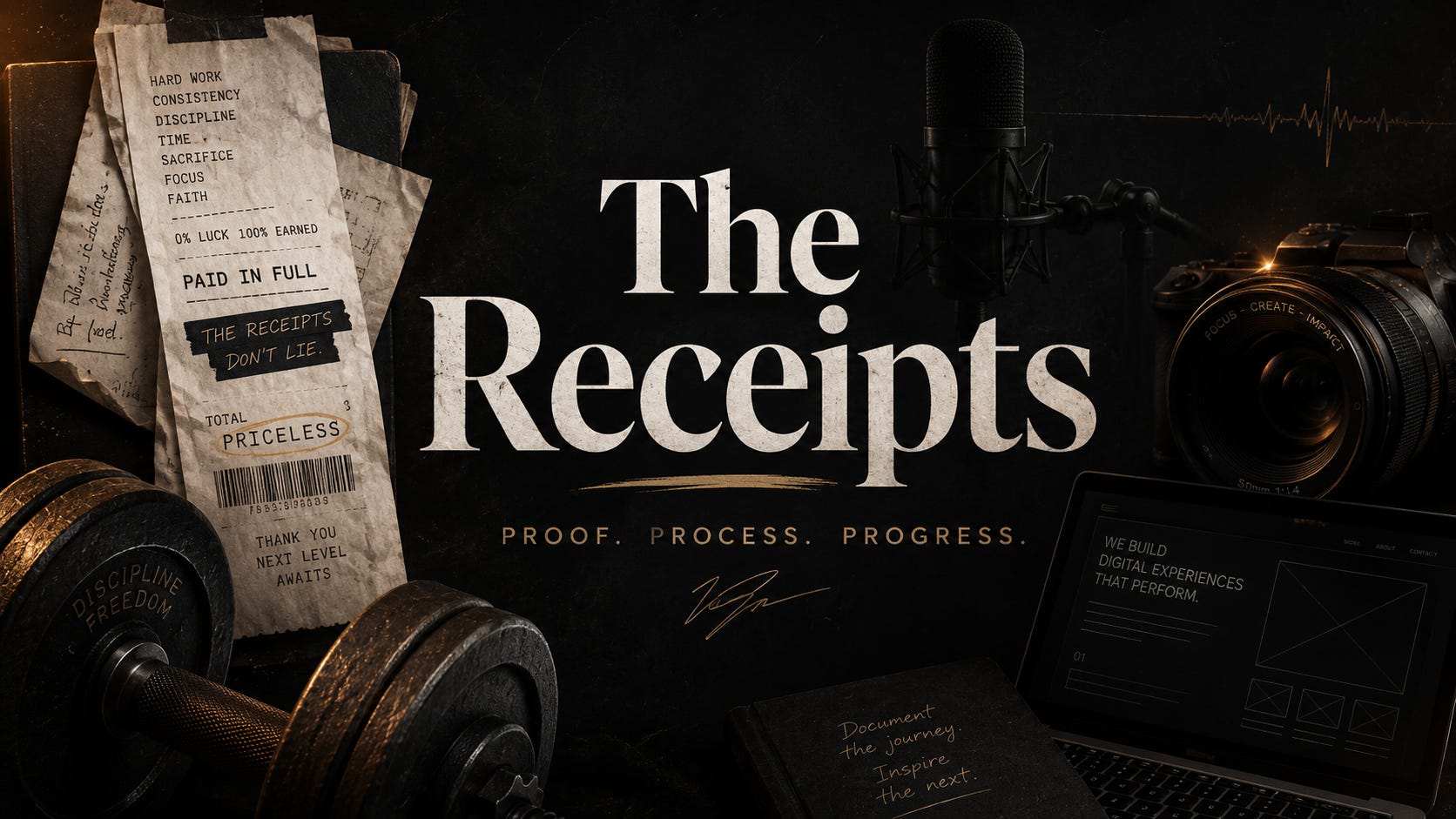
There’s the moment when you’re standing on the edge of something risky, frightening, and potentially life-changing.
Then there’s the moment, years later, when you look back and realize you outlasted almost everyone who told you not to do it.
I’ve been reflecting a lot lately on how my career has evolved.
It began with two part-time roles in fitness while I was still working full-time outside of fitness. At the same time, I was enrolled in the Personal Training Specialist program at NAIT and completing my CanFitPro certification.
It was a lot.
It was also the beginning of something far more substantial than I could fully see at the time.
It’s funny that I use the word evolved, because for six and a half years, I worked as a contractor out of a gym called Evolve Strength.
During that time, I watched Evolve grow from a warehouse gym into one of the most visible fitness facilities in South Edmonton, filled with state-of-the-art equipment and a community of driven coaches and business owners operating under one roof.
I genuinely wish them continued success.
But this article isn’t about their vision. Because I’ve found greater success on a new path in a private gym/
This article is about something I can truly call mine.
I Was Already Doing This Before I Had a Career
Between the ages of 13 and 18, I was already doing much of what would eventually become my career.
My first paid video-editing project was for a retired dentist who was leaving his practice in Wetaskiwin. My neighbour, who worked as his receptionist, hired me to help make a farewell video for him.
At the time, it felt enormous.
Not because it was a large commercial production, but because it mattered to someone. There were expectations attached to it. There was a story to tell, and I was responsible for helping tell it properly.
Not long after that, my gym and math teacher and his wife hired me to build a website for their taekwondo school.
I used Adobe Flash to create a custom intro animation and Dreamweaver to code the website. The process was profoundly different from the platforms and technology stacks available today.
There were no polished drag-and-drop builders capable of doing most of the work for you.
There was a prerequisite level of skill, patience, and problem-solving involved. You had to be willing to learn things you did not yet understand.
My computer teacher lent me stacks of web-design magazines to help with the process. I went to the bookstore with my parents and bought more for myself.
Those magazines came with CDs containing templates, fonts, software, and design tools that could help expedite small parts of the process.
That was the education.
You learned by building.
You learned by getting stuck.
You learned by trying to make something work long before you had any evidence that you were particularly good at it.
Looking back, those were not random teenage hobbies.
They were early repetitions.
They were the beginning of the compound effect.
I Never Forget the Haters
Something I do—and this may be my most toxic trait—is remember every person who doubted me.
I have never been particularly good at forgetting the voices of the people who warned me not to leave my former career.
The people who told me I would fail.
The people who believed I was moving backwards rather than forwards.
The people who essentially staged interventions and sent me job postings from completely different industries, convinced that I needed to find something safer, more conventional, or more respectable.
Those voices have echoed in my head for years.
They will probably continue to echo for many more.
Not in a crippling way.
In a deeply motivating way.
Because today, when someone asks what I do for work, the answer is no longer simple.
I coach people.
I produce podcasts.
I create videos.
I design websites.
I develop brands, systems, campaigns, and content.
I help people communicate more effectively and build businesses that are easier to find, understand, and trust.
I have built a career around skills that many people treated as distractions, side projects, or temporary experiments.
And nearly every business that once decided I was not worth hiring has, for better or worse, closed its doors, reduced its locations, changed ownership, or become a smaller version of what it once was.
That doesn’t mean I celebrate anyone else’s failure.
It means the people warning you about your future are not necessarily qualified to predict it.
Sometimes they are operating from fear.
Sometimes they are measuring your potential against the limitations of their own imagination.
Sometimes they are simply wrong.
The Receipts
Reflection is one thing.
Receipts are another.
I recently finished redesigning fettleandfood.com and aimfitnessyeg.ca.
I’m currently designing or redesigning invigoratetraining.com and chrisliddlemedia.com.
Depending on when you read this, I may also be in the middle of—or finished with—the latest revamp of christianliddle.com.
I also have three additional websites in the fitness industry pending over the next two months.
That is not hypothetical work.
It is not a vision board.
It is not a plan I hope to begin someday when I feel ready.
It is the work already in front of me.
At the same time, I’ll be producing and consulting on more podcasts. My most recent consultation was with a coach from Norway who is building his own show and looking for a clearer system around its strategy, equipment, workflow, and growth.
The scope of my work is expanding geographically as well as professionally.
I’m not just helping people within one gym, one city, or one narrow service.
I’m helping coaches improve their businesses, communicate their ideas, build platforms, create content, and develop systems that allow their work to reach further.
Through all of this, I have no plans to slow down when it comes to helping people with their fitness and nutrition.
That work still matters to me.
The goal was never to abandon coaching in order to pursue media.
The goal was to build a career large enough to hold both.
Training and media are not competing identities.
They reinforce each other.
Coaching has taught me how to listen, lead, simplify complicated ideas, build trust, and help people act when they are afraid or uncertain.
Media has taught me how to capture attention, shape a message, tell a story, create leverage, and make valuable work easier to discover.
One helps people change.
The other helps people understand why that change matters.
Building Two Things at Once
Against the advice of most people, I am building a training business while simultaneously building a media agency.
That may sound unfocused to someone who believes a person must fit neatly into one professional category.
To me, these businesses belong together.
The long-term vision is not for me to personally perform every task forever.
I will eventually need contractors and team members to help me deliver the work.
Does that mean compromise?
No.
It means elevation.
The belief that nobody else can meet your standards is not always evidence of excellence. Sometimes it is evidence that you have failed to communicate, teach, lead, or create systems.
Empowering other people does not have to dilute the vision.
Done properly, it expands it.
Different perspectives strengthen the work. Diverse thought processes expose blind spots. Strong leadership allows a group of talented people to build something better than any one person could produce alone.
That is how organizations survive.
That is how ideas grow.
That is how some businesses endure while others slowly fade away.
My goal is to take what has helped me endure individually and transpose it into something that helps a team succeed collectively.
Not merely survive.
Skyrocket.
The Mentorship
That same thinking has also changed the way I approach mentorship.
My most recent mentee has had nothing but positive things to say about her experience. Just as importantly, working with her taught me something about how I should deliver the service going forward.
The best version of the mentorship is not built around putting someone into a large group and expecting a library of information to do all the work.
It is built around focused, one-to-one conversations.
The prerecorded education is still valuable. There is a full library of material covering the systems, tools, strategies, and lessons I have accumulated over the years.
But the library is the bonus.
The real service is the conversation.
It is the ability to sit down with someone, understand the business they are trying to build, identify the obstacle directly in front of them, and help them determine what to do next.
That matters because my experience has never existed inside a single lane.
I spent three and a half years working inside a business coach’s company.
I have more than eight years of experience in podcast production.
I have been designing websites, editing videos, and creating media for more than a decade.
I spent six years working professionally in social media management.
Out of high school, I was selected for a film-school intensive.
I shadowed inside a news studio.
I worked with a print magazine, sold advertising, and learned how creative work connects to the commercial realities of running a business.
There is more, but the point is not to recite a résumé.
The point is that when someone brings me a problem, I am rarely looking at it from one angle.
I can look at the offer.
The website.
The messaging.
The content.
The systems.
The production process.
The sales journey.
The client experience.
The way all of those pieces either support one another or quietly work against each other.
That is difficult to replicate with a generic course.
A course can give you information.
A focused conversation can help you decide which information actually matters right now.
It can also prevent you from spending the next six months building the wrong thing.
The mentorship is for people who want access to the full range of what I have learned, but who also want help applying it to their specific situation.
The prerecorded education gives you a foundation.
The one-to-one calls help you build on it.
If you have questions about the mentorship, what it covers, or the full library of prerecorded education included as a bonus, simply reply to this email.
Looking for the Right Person
In a perfect world, I would also find an intern who wants to get into the industry and shadow me.
Someone who is curious.
Someone who wants to learn how coaching, content, podcasting, websites, production, sales, and client relationships connect in the real world.
Someone who understands that the opportunity is not merely to watch me click buttons or complete tasks.
It is to see how a business is built while it is still being built.
But we do not live in a perfect world.
The right person may not appear on the exact timeline I would prefer.
They may not have the exact experience I think I need.
I may have to keep looking longer than expected.
And while I look for the person who meets the criteria, the work still has to move forward.
So I will put one foot in front of the other.
I will keep coaching.
I will keep building.
I will keep producing.
I will keep refining the systems until the right person has something worthwhile to step into.
The team does not begin when the first person is hired.
It begins with the standards, structure, habits, and opportunities you create before they arrive.
Add More Seats
There is a version of entrepreneurship that is almost entirely self-serving.
Build your own platform.
Protect your own opportunities.
Own the table.
Make sure everyone knows it belongs to you.
I’m less interested in that version than I used to be.
It is far better to add more seats to a table than it is to build a table only you are allowed to own.
The next phase of my career is not simply about proving that I was right to take the risks I took.
It is about creating more opportunities because I took them.
It is about helping other people develop skills, earn money, build confidence, and produce work they are proud to attach their names to.
It is about taking years of accumulated experience—coaching, editing, production, design, communication, sales, leadership, and problem-solving—and turning it into something larger than my own workload.
The receipts matter because they prove the risk was not reckless.
They prove the work was compounding, even when it looked scattered from the outside.
They prove that the skills people dismissed were becoming an ecosystem.
And they prove that the people who thought I was moving backwards may not have understood the direction I was travelling.
What Does This Have to Do With Your Friday?
Maybe more than you think.
1. Your harshest critics may be objectively wrong.
They may also become life-changingly helpful.
Not because their criticism was accurate, but because it gave you something to push against. It forced you to define what you believed strongly enough to pursue without their approval.
2. Your past experiences are why your future can be bright.
The things that once appeared disconnected may eventually become the exact combination that makes your work difficult to replicate.
Very little is wasted when you pay attention to what each season taught you.
3. Experience compounds.
Skills compound.
Relationships compound.
Reputation compounds.
The small project you take seriously today may become the foundation of a business you cannot yet imagine.
You may not recognize its value while you are standing on the edge of the risk.
You may only understand it years later, when you turn around and realize how far you have travelled.
And how many people you outlasted.
Share this with someone.
Impressive read Chris Liddle. I've heard and read so many things about you and your career. I am always interested and looking forward to more of what you have to offer and share.