
The Protocol Doesn’t Care What You Look Like

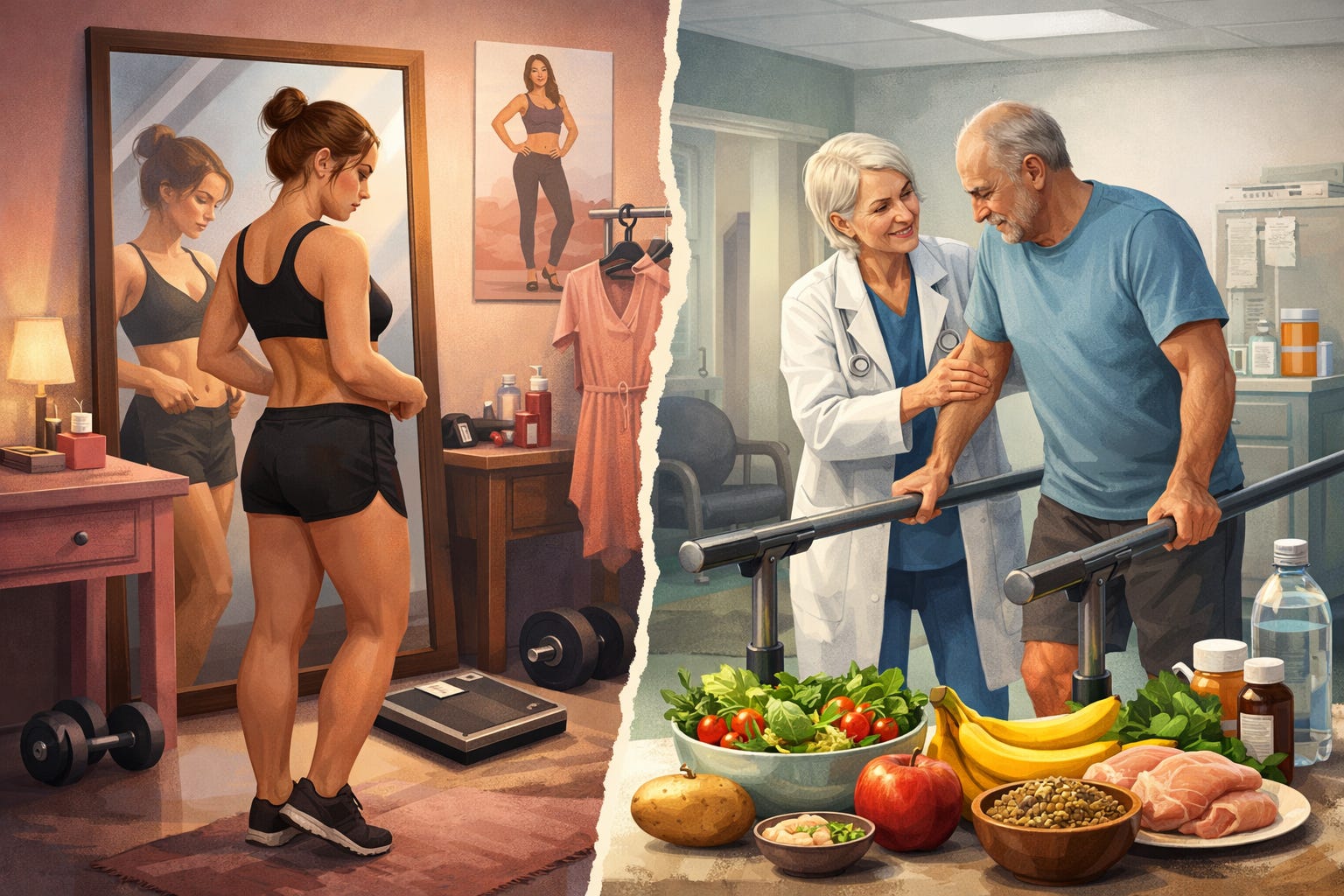
If you sat down with a really good physiotherapist - the kind who’s seen thousands of bodies, injuries, surgeries, recoveries, setbacks, and comebacks - they wouldn’t start by asking how you feel about your reflection.
They’d ask how stable you are.
How strong you are.
How confidently you can move through the world without falling, breaking something, or losing independence.
And if your fall risk was high, the protocol would be boring, unsexy, and non-negotiable:
You would need to strength train.
Not because it makes your legs look a certain way.
Not because it earns you praise.
But because strong muscles, bones, and connective tissue keep you upright and alive.
The mirror wouldn’t get a vote.
The same thing happens on the nutrition side.
If someone was dealing with organ dysfunction — liver issues, kidney stress, metabolic disease — a good physician wouldn’t frame food as morality, willpower, or identity.
They’d frame it as inputs and outputs.
More whole foods.
More vegetables.
More lean sources of protein.
Micronutrients from food first.
If potassium was needed, it wouldn’t come from a supplement aisle aesthetic — it would come from a banana or a potato.
If fiber was needed, it wouldn’t come from a detox tea — it would come from apples, oats, beans, whole grains.
Again, the protocol wouldn’t care how “disciplined” you felt.
It would care whether your body was being supported.
Somewhere Along the Way, We Lost the Plot
In fitness and nutrition spaces, we’ve slowly drifted away from care and toward appearance.
Movement became about how it made us look.
Food became about whether we were “good” or “bad.”
Health became something you earn only if you hate yourself enough first.
That’s a brutal starting point.
Because when everything is framed through body image, people quietly start to believe that looking better is the prerequisite for deserving better.
More energy.
More confidence.
More longevity.
More life.
But that’s not how any competent medical or rehabilitative system works.
No one tells a patient:
“Once you like your body, then we’ll strengthen it.”
“Once you feel worthy, then we’ll reduce your risk of falling.”
“Once you earn it, then you get care.”
The intervention comes first.
The dignity is assumed.
The Crossroads Isn’t You Being “Not Enough”
This is the part that matters most.
The crossroads isn’t that you’re lazy.
It isn’t that you’re broken.
It isn’t that you haven’t suffered enough to deserve a better life.
The crossroads is philosophical.
Do we treat health as punishment for not measuring up?
Or do we treat it as maintenance for a life we intend to keep living?
Because a life well lived is rarely not merit-based.
You earn it by showing up.
By adapting.
By learning.
By continuing even when it’s uncomfortable.
Not by being perfect.
Not by looking a certain way.
Not by shrinking yourself into someone more “acceptable.”
Strength training isn’t vanity — it’s insurance.
Whole foods aren’t restriction — they’re raw materials.
Care isn’t something you graduate into — it’s something you’re allowed to receive now.
You Are Not Disqualified From an Abundant Life
If there’s one thing I want no one to walk away believing, it’s this:
You don’t have to become someone else to deserve a full life.
You don’t have to hate your body into compliance.
You don’t have to punish yourself into health.
You don’t have to prove your worth through suffering.
You are allowed to be strong because strength keeps you safe.
You are allowed to eat well because your organs rely on it.
You are allowed to care for yourself because you plan on being here — fully — for a long time.
That isn’t vanity.
That isn’t weakness.
That’s stewardship.
And it’s a far better place to begin.
This is a valuable article to read. It's so important to remember the real reason to strengthen your body and eat healthy.